

Finding skilled professionals for mission-critical construction projects - like data centers, energy facilities, and advanced manufacturing - is challenging. With 91% of construction employers reporting severe skill shortages, choosing the right recruitment agency is essential. This article reviews six standout agencies based on their expertise, vetting processes, speed, and pricing.
Here’s a quick breakdown:
Each agency has unique strengths tailored to specific project needs. Whether you prioritize speed, technical vetting, or flexible pricing, the right partner can ensure your projects stay on track and meet technical requirements.

Top 6 Construction Project Management Recruitment Agencies Comparison
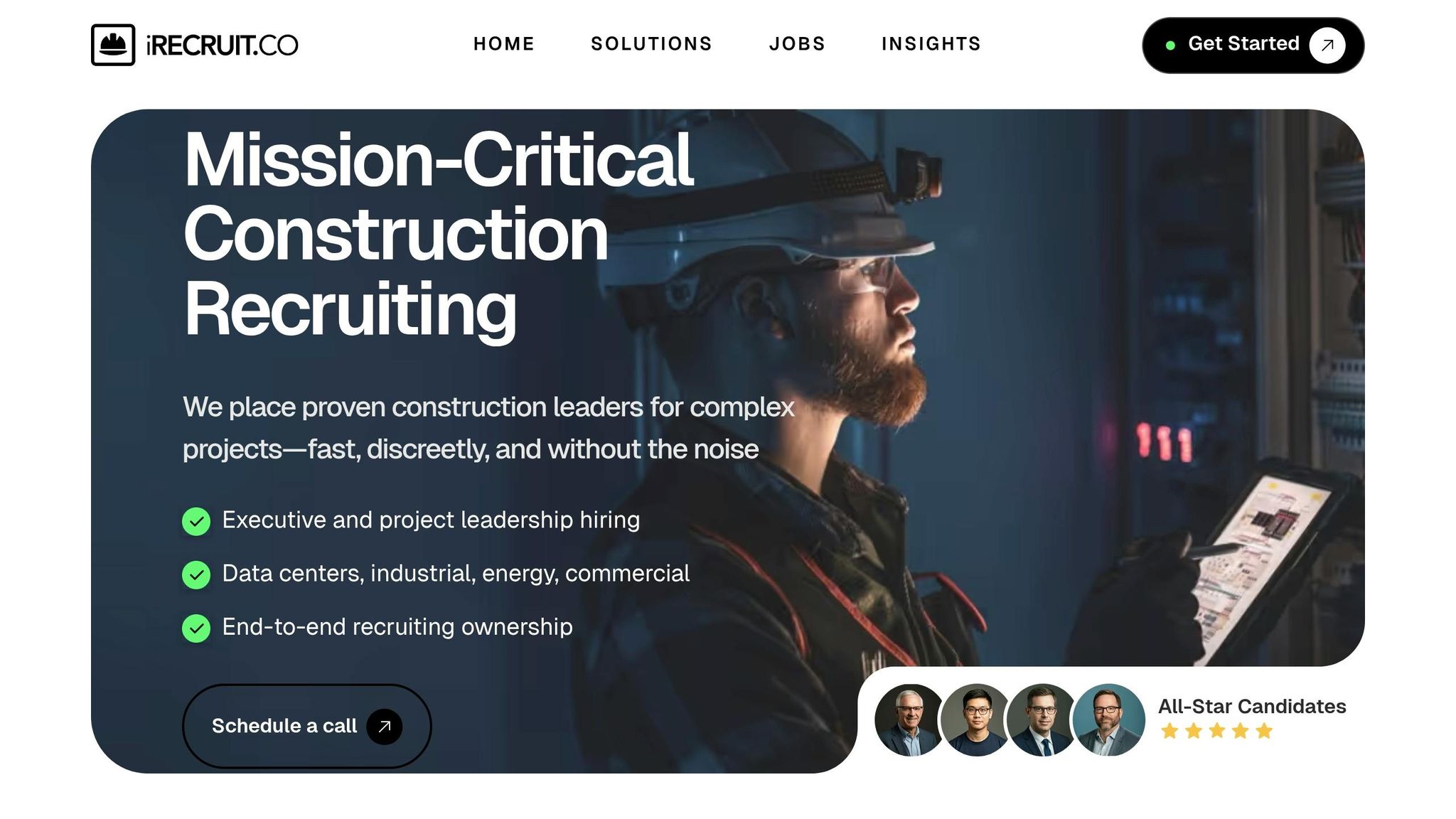
iRecruit.co focuses exclusively on mission-critical construction, catering to industries where downtime can’t be tolerated. Their expertise lies in sectors like data centers, industrial facilities, energy projects, and intricate commercial builds. Instead of trying to cover a wide range of industries, they zero in on roles that require advanced technical knowledge - think MEP coordination, critical systems engineering, commissioning, and project controls.
This sharp focus is especially vital for large-scale projects, such as $400M+ developments or 100MW data centers. Success in these areas often hinges on understanding details like Tier III versus Tier IV distinctions. With over 200 completed projects and a 90% client retention rate across more than 70 clients, iRecruit.co demonstrates a proven ability to deliver highly skilled candidates for power and energy infrastructure. Their targeted approach ensures a tailored candidate selection process that aligns with the unique demands of these sectors.
Their candidate vetting process is thorough and deliberate. It begins with a discovery call to outline the Ideal Candidate Profile. From there, recruiters conduct phone screenings to confirm technical qualifications and ensure compensation expectations match the role. Candidates are pre-qualified based on interest, salary alignment, and formal recommendations.
The goal is to complete the hiring process within 30 days. Around Day 21, final due diligence is performed to validate candidates' backgrounds before extending offers. To further ensure client satisfaction, iRecruit.co provides a 90-day search credit: if a hire doesn’t meet expectations within the first 90 days, they’ll find a replacement at no additional cost. This rigorous process guarantees that only top-tier candidates are presented for consideration.
Though headquartered in the United States, iRecruit.co’s expertise extends across international markets. They’ve played a key role in $500M Tier IV data center rollouts on three continents, sourcing top talent for hyperscale facilities. Their global reach makes them a valuable partner for contractors and developers managing multi-site projects, where consistent quality and expertise are essential.
iRecruit.co offers flexible pricing designed to meet the financial needs of high-stakes projects. Their success-based pricing model charges 25% of the first-year salary (or 3% monthly over 12 months) for a single hire. For two active roles, the cost is $4,000 per month per role with a 20% success fee. For three or more active roles, the monthly fee drops to $3,500 per role, while the 20% success fee remains unchanged.
This comprehensive service can either replace or supplement an internal talent acquisition team, handling everything from candidate searches to onboarding. iRecruit.co specializes in recruiting for pivotal project leadership roles, such as Construction Project Managers, Superintendents, and MEP Coordinators. They also tackle executive-level assignments, including VP-level positions and higher, with custom pricing tailored to these assignments.

With three decades of experience, Sequence Staffing focuses on three main construction areas: construction building (residential, industrial, and commercial), heavy and civil engineering (infrastructure like roads, bridges, dams, and tunnels), and specialty trade contracting (mechanical, electrical, and plumbing). Beyond these, the firm also provides staffing solutions for industries critical to manufacturing, science, and engineering. This allows them to supply specialized personnel for both industrial and infrastructure projects. Their expertise extends to navigating complex environmental regulations, recruiting professionals like CEQA/NEPA Project Managers and Regulatory Compliance Managers. For highly technical roles, Sequence Staffing sources specialized engineers in power, hydropower, and control systems, ensuring support throughout the entire project lifecycle - from land acquisition to design and construction [4].
"We are dedicated to supporting organization's globally in building, maintaining and protecting the world's infrastructure, natural resources and environment." - Sequence Staffing [4]
Sequence Staffing employs a "People Hire People" philosophy, focusing on candidates' skills, experience, and how well they align with a company’s culture. Their recruiters stay informed on the latest industry practices, news, and trends, allowing them to address the ever-changing challenges of construction project delivery. Thanks to 30 years of industry connections, they can swiftly identify top-tier talent for specialized, in-demand positions [5].
"The candidates we recruit are more than paper resumes or workers; they are craftsmen, scientists, innovators, and in many cases, artists of their trade." - Sequence Staffing [5]
This thorough approach ensures a smooth and efficient nationwide talent search.
Using their meticulous vetting process, Sequence Staffing extends its reach far beyond local markets. Headquartered in Roseville, California, the company operates across the United States and internationally, primarily serving North America. Their client roster includes Fortune 500 multinationals as well as regional and local organizations. This expansive reach, coupled with a vast industry network, allows them to quickly secure skilled professionals for critical infrastructure projects in diverse locations [6].
Sequence Staffing offers flexible service options, including confidential executive searches, direct-hire placements, and temporary staffing solutions. These customizable models emphasize their dedication to finding the right talent for complex construction projects. Executive searches are handled with strict confidentiality to protect both clients and candidates, covering roles from C-suite executives (CEO, CFO, COO) to highly technical positions like Earthquake Engineers and Geotechnical Engineers [4].
In construction, having leaders who can juggle technical expertise, financial oversight, and people management is non-negotiable - especially for high-stakes projects. Trueline Talent Recruiting zeroes in on construction project management across commercial, residential, heavy highway, heavy civil, and industrial sectors. They excel at finding project managers for specialized areas like electrical, HVAC, plumbing, water/wastewater, preconstruction, concrete, drywall, and framing [7]. This targeted approach ensures they deliver professionals who can handle the technical and managerial demands of complex builds, mitigating schedule risks to keep projects on track and within budget [7].
The demand for construction management roles is solid, with a projected 5% growth from 2022 to 2032, translating to nearly 39,000 annual openings. Median salaries in the field exceed $100,000 [7]. For companies tackling data center builds or advanced manufacturing facilities, Trueline’s expertise in industrial and heavy civil project management offers access to candidates who thrive in high-pressure infrastructure environments.
Trueline takes candidate vetting seriously, evaluating not just technical skills but also industry-specific experience and compatibility with a company’s culture. Their recruiters dig deeper than resumes, seeking professionals who bring a mix of essential skills for data center construction managers, including technical know-how, leadership, and financial savvy [7]. The goal? Long-term placements that stick, not just quick hires.
"I trust Trueline for every hire... Their placements stick which was huge for me." - Jason Davis, President, Maine Coast Contracting [7]
Their curated talent pool includes seasoned leaders and promising managers ready to make an immediate impact. In the Washington D.C. metro area alone, Trueline has over 1,500 pre-vetted professionals, all part of a broader network of more than 50,000 industry contacts [8]. This meticulous process allows them to meet the needs of clients across the country.
Trueline serves construction companies nationwide, offering expertise in navigating the unique challenges of different regions [7][8]. In markets like Washington D.C., they’re well-versed in local regulations, including District Department of Buildings (DOB) requirements, DCRA licensing, and federal security clearances [8].
"Trueline doesn't just send resumes, they deliver high-quality construction pros in a market where good talent is scarce." - Coastal Road Repair [8]
Trueline’s success-based model is designed to be risk-free for clients. Companies can review candidate profiles and conduct interviews without upfront costs - fees are only due upon a successful hire [7]. They also offer a 90-day guarantee on direct hire placements, ensuring satisfaction [8]. With a flexible fee structure that adapts to projects of varying sizes, Trueline demonstrates a commitment to matching top-tier talent with the unique demands of complex construction projects [7].
DAVRON focuses on staffing for industries like engineering, architecture, construction, and manufacturing, with a strong emphasis on project management for residential, commercial, renovation, and restoration projects. What sets DAVRON apart is its expertise in mission-critical infrastructure, including clean power and renewable energy (solar, wind, geothermal, hydrology, and bio-fuels), wireless and telecommunications, and aerospace and defense.
"Our niche focus... allows us to provide you with candidates that will add value to your team." - DAVRON
Their proprietary DavBase database boasts over 600,000 profiles, and the firm highlights a 90.37% candidate retention rate alongside a 90.25% offer acceptance rate [9]. DAVRON’s specialized approach ensures that only the most qualified professionals are presented to clients.
When it comes to mission-critical construction, precision starts with thorough candidate screening. DAVRON employs a "Qualified, Available, and Interested" (QAI) methodology to ensure candidates meet all necessary criteria before being introduced. Each candidate is backed by a detailed DAVRON Report, which includes their skills, salary expectations, and availability. Additional services like drug testing, employment history verification, reference checks, and certification validations are available upon request. By blending advanced data-mining techniques with traditional headhunting, DAVRON identifies both active job seekers and passive candidates capable of handling the technical and leadership demands of high-stakes projects.
DAVRON operates nationwide, with a presence in major U.S. cities like New York City, Washington D.C., Dallas-Fort Worth, Los Angeles, Chicago, Atlanta, Houston, and Seattle. This extensive network allows them to support Fortune 500 companies and large-scale firms with staffing solutions for complex engineering and construction initiatives. Whether it’s a renewable energy project in Texas or a telecommunications infrastructure build in California, DAVRON connects clients with regional talent that matches their specific needs.
DAVRON provides flexible service models to accommodate various hiring requirements. Their contingency search operates on a success-based fee structure, meaning clients only pay if a candidate is hired. For executive or critical roles, their retained search model offers a dedicated recruitment team and prioritized access to top candidates. For temporary or project-based needs, contract staffing is available at fixed, all-inclusive hourly rates.
Additionally, DAVRON offers a Pay-As-You-Go direct-hire option, spreading payments over 52 weeks, along with a one-week free trial and a one-year guarantee. These options are designed to reduce risk and provide dependable staffing solutions for high-stakes projects.
Michael Page Construction stands out with the largest construction recruitment team in the U.S., featuring over 200 recruiters dedicated to supporting general contractors, developers, and project owners across key industries [10]. They focus on high-stakes sectors like data centers and energy infrastructure, sourcing professionals skilled in MEP systems, power redundancy, cooling, and IT infrastructure - expertise crucial for managing projects often surpassing $80 million [13]. Additionally, their recruitment extends to specialized areas such as high-voltage substation builds (12kV to 500kV) and transmission and distribution infrastructure (69kV to 765kV). These capabilities are vital for addressing the demands of large-scale projects, including grid upgrades and Tier IV data center developments [11]. Their rigorous approach ensures they deliver candidates who meet the technical and operational needs of these complex projects.
Michael Page uses a structured four-step process called the "Specialist Search" to match candidates with clients. This includes Discovery and Role Alignment, Market Mapping and Candidate Identification, Shortlist Evaluation and Interviews, and Offer/Transition Support [15]. Clients benefit from a single point of contact who gains a deep understanding of their culture and project requirements, making the vetting process faster and more efficient.
"The fact that Michael Page has assigned one person as the single point of contact for our account has helped streamline our search for qualified candidates... As a result, we are spending less time vetting candidates." - Vice President, LF Jennings Inc. [10]
Their thorough evaluation process includes in-depth interviews, complete reference checks, and optional psychometric testing to ensure both technical proficiency and cultural compatibility. On average, they take just five days to extend a job offer, achieving a 95% client satisfaction rate and a Net Promoter Score of 75 [10][12].
With eight offices across the U.S., including locations in New York, Chicago, Houston, Philadelphia, Boston, Phoenix, and Denver, Michael Page has a strong national presence [10]. Beyond the U.S., their global network spans 36 countries and includes over 5,000 specialized consultants [12]. This extensive reach allows them to connect clients with local talent who possess the right technical expertise, offering flexibility and responsiveness in meeting market demands.
Michael Page offers recruitment solutions for permanent, temporary, and contract positions, catering to roles ranging from entry-level engineers to C-suite executives [10]. Their approach integrates DE&I and ESG principles, supported by tools like salary guides and market trend reports to help clients stay informed and competitive [10][12].
Since its founding in 1981, Kaye/Bassman International has built a strong reputation in construction recruiting, focusing on sectors that demand precision and expertise [16]. Their specialties include Commercial Construction, Architecture & Engineering, Commercial Real Estate, and ConTech, along with a dedicated focus on Energy Infrastructure, Power Generation, and Oil & Gas across upstream, midstream, and downstream operations [16][18][19]. This dual expertise makes them especially adept at handling data center construction and high-stakes energy projects where minimizing execution risks is critical.
For intricate industrial projects, the firm uses its proprietary Market Mastery™ model to locate "A+ talent" with expertise in MEP systems and leadership roles centered on system-focused operations - skills essential for projects with tight schedules [16][3]. Their energy practice extends to highly technical roles such as Petroleum Engineering, Geosciences, and Energy Management. With over 5,000 successful searches for mid- to senior-level construction leadership roles, Kaye/Bassman has proven its ability to manage large-scale, complex project delivery [20][22]. This depth of experience shapes their thorough approach to evaluating candidates.
Kaye/Bassman employs its patented Client Focused Search™ methodology to thoroughly evaluate candidates for technical skills, leadership capabilities, and compatibility with company culture [16][17]. This process prioritizes identifying "intangible qualities" like personality traits and leadership potential - key factors for guiding large organizations effectively [20][21].
"The stakes are particularly high when looking for a new company president. Our relationship with Kaye/Bassman helped us go into the search with confidence in our abilities to get it right." - Steve Cannon, Senior Vice President, Human Resources, Manhattan Construction Company [20]
Operating as the largest single-site search firm in the United States, Kaye/Bassman runs its centralized operations from Dallas while offering nationwide coverage through regional practice leaders [19][20]. The firm has Managing Directors dedicated to regions across the South, West, Midwest, Southeast, and Northeast, ensuring localized market expertise. Beyond the U.S., their network spans 23 countries, which is particularly beneficial for energy clients with strongholds in areas like Houston, Calgary, and the Mid-Continental region [17][18][20][22].
Kaye/Bassman provides flexible placement solutions tailored to client needs, including retained search, contingency search, and professional recruitment services [17][19]. Their commitment to precision and client satisfaction has earned them recognition as the #1 Largest Retained Executive Search Firm by the Dallas Business Journal and a spot among the Top 10 U.S. Search Firms by Executive Search Review [19]. These accolades underscore their ability to deliver reliable, high-quality results.
This section highlights the distinct strengths and challenges of various recruitment agencies specializing in mission-critical construction projects.
Each agency brings specific advantages tailored to different project needs and hiring goals. iRecruit.co shines in mission-critical construction recruitment with its structured 21-day screening process and flexible pricing. Their fees range from a 25% success fee for single roles to as low as $3,500 per role for bulk hires, making it a scalable option for companies with multiple positions to fill [1].
While iRecruit.co focuses on structured timelines and cost-effective options, Michael Page Construction is known for its speed, typically presenting qualified candidates within just five days. However, their pricing model requires a custom consultation to determine costs [14][24]. On the other hand, DAVRON operates on a contingency model, meaning clients pay only when a hire is made. They also provide detailed skills assessment reports, ensuring technical accuracy for engineering and architectural roles [23]. Meanwhile, Kaye/Bassman International has completed over 5,000 mid-to-senior leadership searches, prioritizing cultural alignment through its Client Focused Search™ methodology rather than focusing solely on quick placements [25].
Details on the screening processes and pricing for Sequence Staffing and Trueline Talent Recruiting are less transparent in publicly available materials [2][24]. Agencies like Hays stand out by offering Recruitment Process Outsourcing (RPO) and Managed Service Provider (MSP) solutions for large-scale projects, while NES Fircroft specializes in global mobility and international compliance expertise [2][24].
From a geographical perspective, Michael Page has over 200 recruiters spread across eight U.S. offices, providing extensive market coverage. In comparison, iRecruit.co serves clients across three continents, though specific office locations are not disclosed [1][14].
For businesses managing multiple high-stakes hires, subscription models with reduced success fees might be more economical than traditional contingency-based pricing [1]. Ultimately, selecting the right agency depends on whether speed, technical precision, or flexible risk-sharing aligns best with the unique demands of mission-critical projects [1].
Before you compare individual firms, it helps to decide what kind of partner your project needs. Construction recruiters generally fall into two camps, and picking the wrong one is one of the most common — and costly — hiring mistakes we see.
National, high-volume agencies are built for scale. They run shared candidate pools across many industries and can mobilize quickly for standardized, repeatable roles. If you need to fill a large number of similar positions fast and across several regions, that reach is genuinely useful. The trade-off is depth: a generalist recruiter juggling dozens of unrelated openings rarely understands the difference between a Tier III and Tier IV commissioning lead, and added layers of process can slow down the urgent, specialized hire that actually keeps your schedule intact.
Boutique, specialized agencies work the opposite way. They present a short list of deeply vetted candidates, led by recruiters who live in one industry and know its passive talent, real salary bands, and who is quietly available. For mission-critical leadership roles — the project manager on a $100M data center, the MEP coordinator on a hyperspace build — that precision is what protects your margins. The trade-off is that a boutique firm is not the right tool for spinning up fifty standardized roles overnight.
| What you're optimizing for | National agency | Boutique specialist |
|---|---|---|
| Speed on standardized roles | Fast | Slower, more deliberate |
| Depth of construction expertise | Generalist | Industry veterans |
| Cost structure | Volume-based | Flexible, often premium for niche roles |
| Candidate pool | Broad but less targeted | Smaller, highly targeted |
| Best for | Large-scale, urgent, multi-region staffing | Specialized, senior, high-stakes placements |
Most construction leaders reading this aren't trying to fill a warehouse — they're trying to staff complex builds where one wrong hire ripples through the whole schedule. That's exactly the boutique, specialized lane iRecruit.co operates in: a focused search for the technical and leadership roles that decide whether a project ships on time. If your next critical role can't afford a generalist's guesswork, talk to a recruiter who only does mission-critical construction.
Agency fees can look like an added expense until you price out the alternative. The most expensive line item in construction hiring isn't the recruiter — it's the empty seat and the wrong hire.
Every day a critical role sits open, the meter runs: idle crews, slipped milestones, and overhead that doesn't pause for a vacancy. On leadership roles, the cost of an unfilled seat can reach thousands of dollars a day in lost productivity and schedule penalties. A typical role takes well over a month to fill through traditional channels — six-plus weeks during which existing staff absorb the gap and timelines quietly drift.
Building that capability in-house is rarely cheaper. Between a recruiter's salary, benefits, tooling like an applicant tracking system and sourcing licenses, job-board spend, and the dozens of hours your operations leads burn explaining project specifics, the fully loaded cost of internal recruiting routinely runs well past the headline salary — and senior construction searches can cost tens of thousands of dollars each before a single offer goes out.
Then there's the hidden killer: the bad hire. Replacing a poor mid-management hire in construction can cost a meaningful share of their first-year salary once you factor in re-recruitment, lost productivity, and the downstream scheduling and compliance mistakes a weak leader sets in motion. One wrong project manager doesn't just cost their own seat — it slows every trade behind them.
This is the math that makes a specialized, success-based partner a smart investment rather than a cost. With a model where you pay primarily on a successful hire, gain immediate access to pre-screened, certified candidates, and are backed by a replacement guarantee if a placement doesn't stick, the fee stops being an expense and starts being insurance on your schedule and your margins. When the downside of getting it wrong is measured in days of project delay, paying for precision is the conservative choice.
iRecruit.co is built around exactly that trade: faster, vetted placements for the roles where a mistake is most expensive. See what a focused search costs versus what a vacancy is costing you right now.
When selecting an agency, focus on one whose skills match the demands of your mission-critical projects. For data center or energy initiatives requiring quick hires - like within 30 days - a well-structured recruitment process is non-negotiable. If you need to fill multiple roles, look for agencies offering reduced success fees and dedicated account managers to help cut costs.
Speed is important, but technical expertise is just as crucial. Pre-screened candidates with experience in MEP systems, commissioning, and hyperscale infrastructure can significantly lower the risk of project delays. A strong vetting process ensures you get professionals equipped to handle the complexities of your project.
For companies without internal recruitment teams, full-service agencies can be a game-changer. From crafting job descriptions to negotiating offers, they handle everything - and a 90-day replacement guarantee adds an extra layer of security.
Project complexity should guide your choice. For example, a $400 million data center build requires specialized recruitment knowledge to fill roles like Commissioning Manager or QA/QC Inspector. These positions demand a deep understanding of technical requirements that a generalist recruiter might not provide.
In large-scale projects, fast hiring can make a huge difference in avoiding costly delays. By matching your project’s specific needs with an agency’s specialized expertise, you protect both your timeline and your budget.
Recruiters play a key role when it comes to sourcing highly specialized talent for complex, high-pressure projects. They’re the ones who make sure candidates not only meet the technical and regulatory requirements but also fit the operational needs of industries like data centers, energy, and advanced manufacturing. All of this happens while sticking to tight deadlines and maintaining strict standards. Their strength lies in tailoring workforce solutions to tackle the unique demands of these critical sectors.
To evaluate an agency's screening process effectively, pay attention to their knowledge of your industry and their history of successfully placing candidates in roles like yours. Agencies with well-established networks, access to pre-screened candidates, and the ability to meet tight deadlines - sometimes within just 2–3 days for urgent positions - are worth considering. Also, review their track record, how they assess candidates, and whether they verify certifications such as PMP or OSHA. These factors can help ensure they provide qualified talent quickly and reliably.
When dealing with multiple hires, opting for a retained search or Recruitment Process Outsourcing (RPO) model can be a smart move. These methods are designed specifically for large-scale, essential staffing requirements. They offer dedicated resources and personalized strategies to streamline the process and handle growing demands effectively.