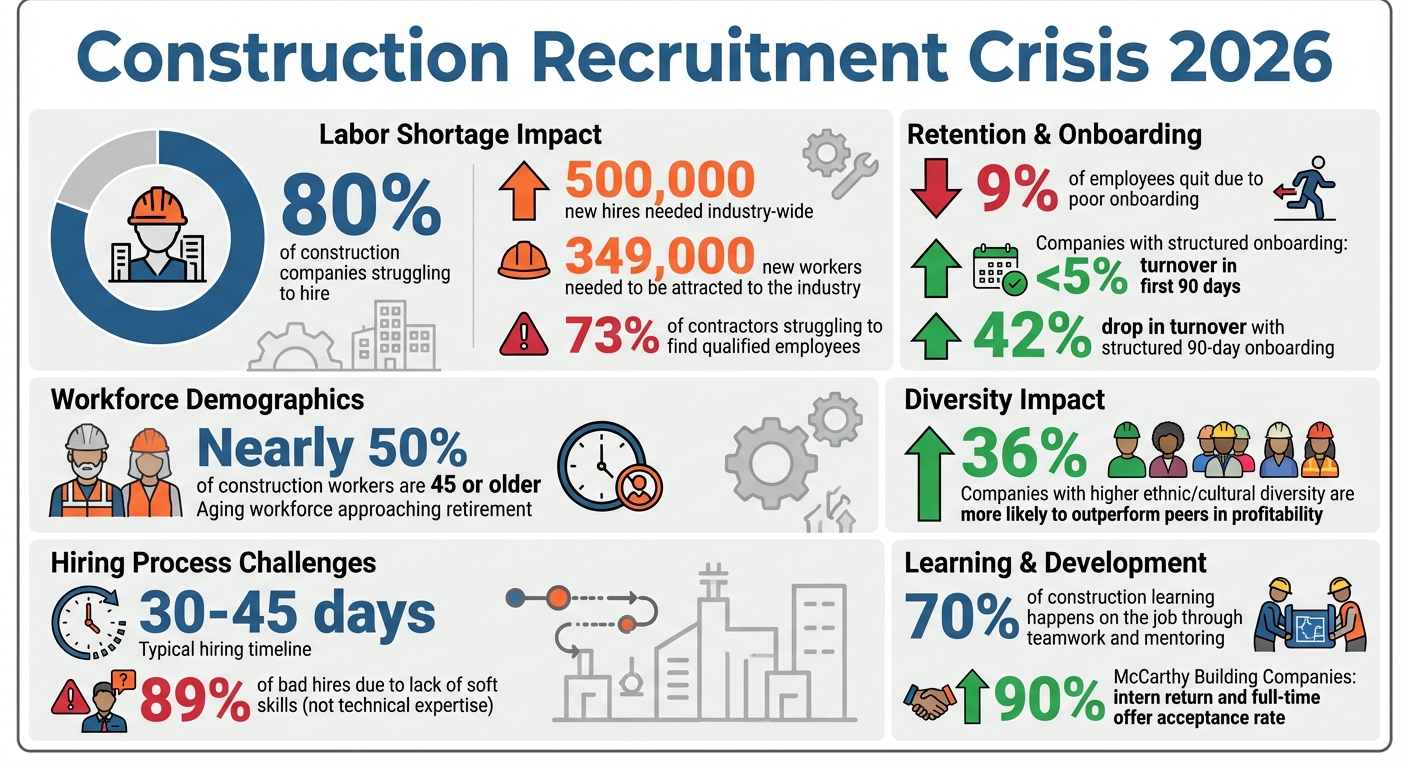
Finding the right talent in 2026 is a growing challenge for construction firms. With over 80% of companies struggling to hire and nearly 500,000 new hires needed, labor shortages are impacting project timelines and budgets. Key positions like MEP Managers, Project Managers, and Commissioning Engineers are critical for sectors like data centers, energy, and manufacturing, but the aging workforce and competition for skilled professionals make hiring harder than ever.
To address this, companies should:
Recruitment is no longer just about filling roles - it's about securing experienced leaders and specialists to keep projects on track and avoid costly delays.
Construction Industry Labor Shortage Statistics and Key Hiring Challenges 2026
Mission-critical projects in sectors like data centers, energy, and manufacturing rely heavily on specialized teams to ensure success. Among these roles, MEP (Mechanical, Electrical, and Plumbing) Managers stand out as essential. These professionals act as the glue that integrates complex systems like HVAC, UPS, and plumbing, ensuring they function together seamlessly. To qualify, MEP Managers typically need a Bachelor's degree in Mechanical or Electrical Engineering, while a PE license, OSHA 30 certification, and expertise in BIM/VDC tools (such as Revit, Navisworks, and BIM 360) are highly desirable. By 2025, average salaries for this position are projected to range from $115,000 to $145,000 nationally, with regions like the Bay Area offering higher compensation, between $135,000 and $165,000.
"MEP systems - mechanical, electrical, and plumbing - are the heart of any mission-critical facility. If the HVAC fails in a hospital, or the UPS goes down in a data center, it's not just a problem - it's a crisis." - iRecruit
Other critical roles include Project Managers, who oversee multimillion-dollar budgets and lead diverse teams, and Commissioning Engineers, responsible for system startups and functional testing. HSE (Health, Safety, Environment) Managers focus on cultivating safety cultures and ensuring compliance, while Procurement Managers and Project Controls specialists handle vendor relations, scheduling, and cost tracking. These roles form the backbone of successful mission-critical projects, addressing talent shortages and the increasing complexity of these endeavors.
While technical roles ensure the smooth operation of projects, leadership positions are essential for setting the strategic vision and steering overall success. Construction Directors and Project Executives take on this responsibility, managing team dynamics, governance, revenue tracking, and forecasting for large-scale projects. These roles require a distinct skill set, emphasizing emotional intelligence, strong communication, and the ability to navigate crises, such as supplier failures or unexpected design changes.
The importance of soft skills in leadership cannot be overstated. Research shows that 89% of "bad hires" are due to a lack of soft skills rather than technical expertise. For Engineering, Procurement, and Construction (EPC) projects, which often demand the rapid mobilization of entire teams within 30 days of a contract award, leaders must not only think strategically but also inspire confidence among stakeholders.
Veterans in the industry often recommend building a solid technical foundation before transitioning into leadership. Spending 5–15 years in hands-on roles provides the experience and credibility needed to lead effectively. This approach also offers better job security, as technical roles are considered more stable than managerial positions by a ratio of more than 5 to 1.
"Hiring for Engineering, Procurement, and Construction (EPC) projects isn't just about filling a role. It's about putting the right person in place to hold the entire structure together." - Advastar
Start building your team before the project officially begins. Waiting until contracts are signed can leave you scrambling to fill critical roles. A better approach? Keep a steady pipeline of pre-qualified candidates through networking and connections within industry associations.
Before posting job openings, take a moment to revisit the role’s responsibilities and Key Performance Indicators (KPIs). This step ensures the position aligns with the project’s current needs rather than outdated job descriptions. For large-scale, high-stakes projects, workforce planning is a must. The ongoing labor shortages mean employers need to offer competitive salaries and premium compensation packages to attract top talent.
Here’s a key challenge: nearly half of construction workers are 45 or older. As this group nears retirement, experienced site managers are becoming harder to find. For owners, general contractors, and EPC firms managing complex projects like data center construction, energy infrastructure, or advanced manufacturing, strategic workforce planning is no longer optional - it’s essential. Once your plan is in place, the focus shifts to finding pre-screened candidates who meet these refined criteria.
Generalist staffing agencies often fall short when it comes to sourcing the specialized talent needed for construction projects. Instead, partner with firms that specialize in construction recruitment and have established relationships with sought-after professionals like Project Managers and Superintendents. These experts understand the technical and interpersonal skills required, helping you identify the right fit quickly.
"Organizations should never settle for subpar talent. This will cost them more in the long run, rather than finding and hiring the best candidate the first time." - Jeff Raymond, President and Founder, Raymond Search Group
To reach skilled candidates, leverage specialized job boards like Careers in Construction or ToolBelt. For niche roles, try trade-specific platforms like Strictly Plumbers or Electrician Jobs. Building relationships with trade schools is another smart move - participate in advisory boards to help shape their curriculum and gain early access to promising graduates.
Referral programs can also work wonders. Consider a tiered system with milestone bonuses to encourage quality recommendations. Once you’ve identified the right candidates, speed up the hiring process to secure them before competitors do.
Fast-tracking your hiring process is critical for staying on schedule with complex projects. Use tools like Applicant Tracking Systems (ATS), skill-based assessments, and standardized interview playbooks to evaluate candidates efficiently.
Keep the candidate experience smooth and professional. Provide clear next steps, avoid rescheduling interviews, and maintain regular communication to prevent candidates from losing interest or ghosting. A speedy process doesn’t mean sacrificing diversity - companies with higher levels of ethnic and cultural diversity are 36% more likely to outperform their peers in profitability. Keep this in mind while streamlining your approach.
Digital onboarding platforms can also make a big difference. They allow new hires to access essential documents and training materials online, ensuring consistency regardless of location. This is especially important since most job seekers rely on mobile devices during their search.
"Hiring is just the beginning. To reduce turnover, focus on culture and continued development." - HighMatch
In today’s competitive market, keeping your top construction talent requires more than just offering a paycheck. It’s about creating clear growth opportunities and ensuring compensation stays competitive. Competitive pay is the cornerstone - regularly review industry trends to ensure your salaries, bonuses, and benefits are on par with or better than your competitors. Think beyond the basics by offering perks like transportation subsidies, childcare assistance, or funding for continuing education to address modern workforce needs.
A defined career path can make all the difference. Employees are more likely to stay when they can see a clear trajectory for advancement. One effective approach is mentorship. Take McCarthy Building Companies as an example: in February 2026, they reported a 90% return and full-time offer acceptance rate for their nearly 300 interns across over 100 projects. Their "top talent mentoring initiative" pairs 25 emerging leaders with senior superintendents for monthly jobsite shadowing. This works because about 70% of construction learning happens on the job through teamwork and mentoring.
Investing in upskilling opportunities, especially in high-tech areas like Building Information Modeling (BIM), drone mapping, or cloud-based scheduling tools, also helps retain talent. When employees see their employer investing in their professional growth, they’re less likely to seek opportunities elsewhere.
"If you are paying your employees fairly, compensation may not be the biggest motivator for retention." - CLA
While career development and pay are key, a strong onboarding process plays a critical role in keeping employees engaged.
Retention begins with how you welcome new hires. A poor onboarding experience can drive 9% of employees to quit shortly after starting. Avoid this by replacing one-day orientations with a 90-day onboarding plan that builds confidence and a sense of belonging over time. Use cloud-based tools to handle administrative tasks before Day 1, allowing new hires to focus on connecting with their team and understanding their role.
Structure your onboarding process with clear milestones. For example:
One Oregon concrete contractor implemented this structured onboarding system through Contractor Staffing Source, adding weekly check-ins and Day 60 stay interviews. Within six months, they saw a 42% drop in turnover and promoted two new crew leads from within.
"When you invest in onboarding construction employees with coaching and clarity, you don't just keep workers - you build future leaders." - Paul Sanneman, Contractor Staffing Source
Frequent feedback is another essential tool. Replace annual reviews with regular check-ins - weekly or monthly - to address issues early and reinforce positive habits. Tools like the Predictive Index can help managers understand what drives each employee, enabling more personalized support. Celebrate milestones, like service anniversaries or project successes, with events that include employees’ families to build a sense of community and loyalty.

When it comes to mission-critical construction projects, every hire can make or break the timeline. iRecruit.co focuses on fast, high-quality placements to ensure your projects stay on track.
iRecruit.co specializes in recruiting construction professionals for sectors like data centers, energy infrastructure, and advanced manufacturing. The process kicks off with a Discovery Call to establish a candidate matrix and craft an Ideal Candidate Profile (ICP). Every candidate undergoes a thorough phone screening to evaluate their technical skills, genuine interest, and compensation expectations. This meticulous pre-qualification process has led to a 90% client retention rate and the completion of over 200 projects for more than 70 clients.
To further build confidence, iRecruit.co offers a 90-day search credit - if a new hire doesn’t meet expectations within the first 90 days, a replacement is provided at no additional cost. The team’s internal goal? To move from the initial discovery phase to an accepted offer in just 30 days, ensuring projects stay on schedule in today’s competitive hiring landscape.
This structured approach not only ensures top-tier talent but also supports a flexible investment model that adapts to your hiring needs.
iRecruit.co’s pricing plans are designed to scale with your hiring volume, providing flexibility and predictability. The subscription model blends monthly fees for active roles with success fees that decrease as you hire more candidates. This approach turns recruiting into a predictable investment rather than a fluctuating expense - ideal for companies managing multiple large-scale construction projects.
| Plan | Monthly Fee (Per Active Role) | Success Fee (of 1st Year Salary) | Best For |
|---|---|---|---|
| 1 Open Role | $0 | 25% (or 3% monthly for 12 months) | Single critical hires or low-volume needs |
| 2 Open Roles | $4,000 | 20% (or 2% monthly for 12 months) | Small project teams or growing GCs |
| 3+ Open Roles | $3,500 | 20% (or 2% monthly for 12 months) | Large-scale EPC projects and rapid scaling |
Monthly fees only apply while a role is actively being sourced. Once filled, the fee is either removed or reduced.
Beyond mid-level hiring, filling leadership roles demands a faster, more targeted approach. iRecruit.co’s executive search is built for this, leveraging a pre-screened database of proven leaders, including Program Directors, Commissioning Managers, and Construction Executives.
The process follows a 21-day roadmap:
This efficient timeline is critical for addressing leadership gaps that could otherwise derail project success.
The challenges facing the construction industry today call for a smarter, more focused approach to hiring. With the need to attract 349,000 new workers and 73% of contractors struggling to find qualified employees, the importance of strategic workforce planning cannot be overstated. Success depends on prioritizing the right mix of technical skills and adaptability over simply filling open positions.
"Success will depend on long-term workforce planning, smarter recruitment strategies, and sustained investment in people and technology." - Sierra Swanson, Davron
Hiring effectively isn’t just about meeting quotas - it’s about directly influencing project timelines and profitability. Companies that implement structured onboarding processes report turnover rates of less than 5% in the first 90 days. For owners, general contractors, and EPC firms working on data centers, energy infrastructure, and advanced manufacturing projects, reducing the typical 30- to 45-day hiring timeline can mean the difference between staying on schedule and costly delays.
This approach pairs seamlessly with strong career development and onboarding strategies, laying the groundwork for long-term success. Tools like iRecruit.co offer solutions tailored to the industry, with pre-screened candidate databases, flexible pricing models, and a 90-day search credit for replacements. From executive-level hires to skilled specialists, these resources help ensure projects stay on track. For additional insights into workforce trends, visit our jobs and workforce resources.
In a world where labor shortages and technological demands are reshaping the construction landscape, effective hiring practices are no longer optional - they’re essential for completing complex projects on time and within budget. By adopting these strategies, firms can meet the critical demands of today’s construction industry.
Start by bringing on board project managers, MEP coordinators and engineers, and commissioning specialists. These professionals play key roles in ensuring the smooth execution of complex projects. Project managers oversee the overall feasibility and timeline, MEP coordinators and engineers handle critical systems like mechanical, electrical, and plumbing, and commissioning specialists ensure everything meets required standards before launch. Their combined expertise helps keep projects on track and up to par.
Reducing time-to-hire without sacrificing quality requires a proactive approach. Start with early workforce planning to anticipate hiring needs and ensure you're ahead of the curve. Clearly outline job roles and technical requirements from the beginning - this helps attract the right candidates faster.
Using structured interviews and behavioral assessments streamlines the evaluation process, allowing you to identify top talent efficiently. For specialized roles, consider working with expert recruiters who have access to pre-screened talent pools. This partnership can speed up placements while maintaining high standards.
Reducing early turnover in construction teams means tackling challenges like job satisfaction, career development, and workplace stability head-on. To achieve this, start with structured onboarding that sets clear expectations and provides a strong foundation. Pair this with comprehensive safety training to ensure workers feel secure and valued.
Creating a positive work environment is equally important. Encourage open communication, recognize achievements, and provide opportunities for growth. Beyond that, focus on accurate workforce planning to avoid overloading your team. Offering competitive pay, clear paths for career advancement, and mentorship programs can go a long way in preventing burnout and building loyalty - especially for teams managing demanding projects, such as data centers or energy infrastructure.