

Construction companies face a critical labor shortage, with 246,000 open positions as of 2025 and 92% of firms reporting hiring challenges. Recruitment agencies are stepping in to solve this problem by connecting businesses with pre-screened candidates, reducing hiring timelines, and offering expertise in construction-specific roles and certifications. Here's what you need to know:
Recruitment agencies streamline hiring for critical projects like data centers and infrastructure builds. Their expertise can help avoid costly delays and keep projects on track.
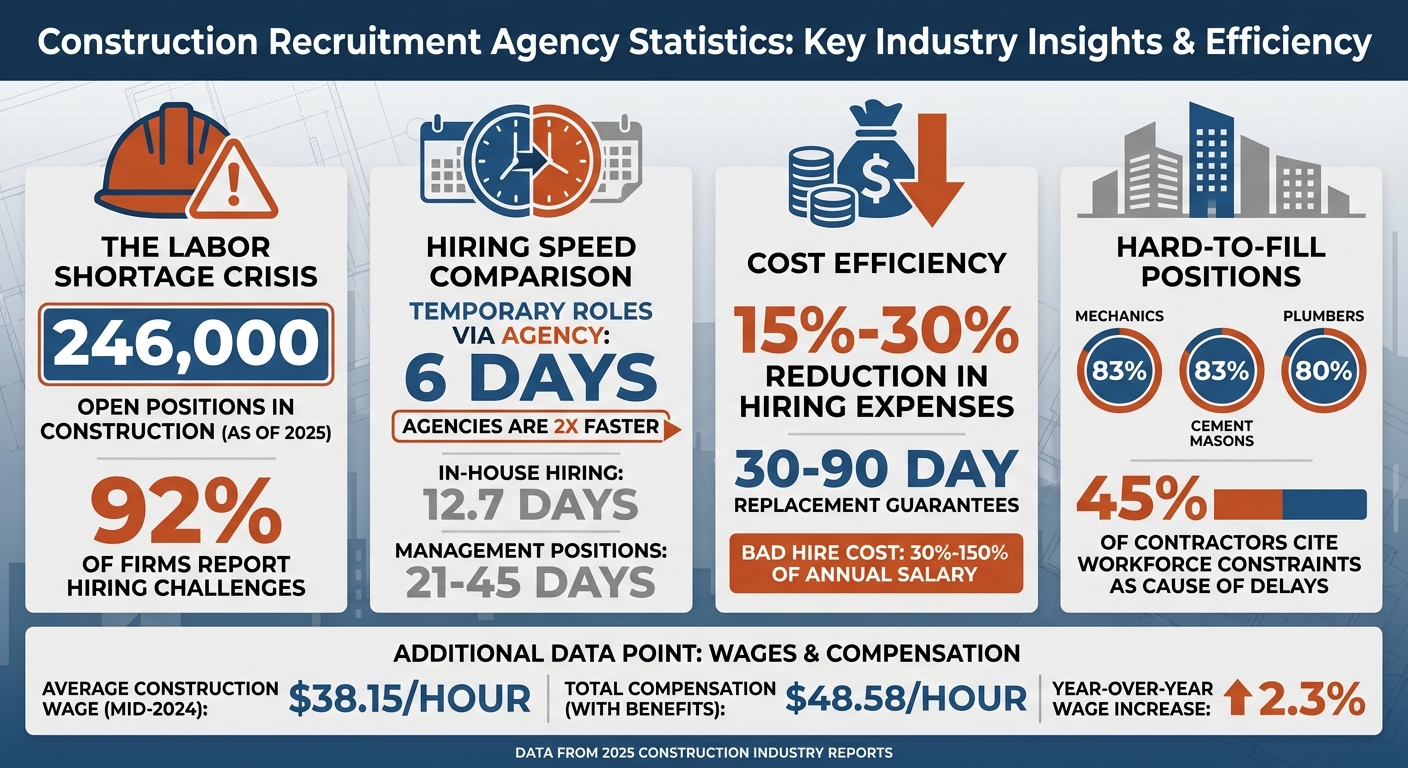
Construction Recruitment Statistics: Labor Shortage, Hiring Speed, and Cost Savings
Understanding the key roles in mission-critical construction projects highlights how recruitment agencies address staffing gaps that could derail timelines and budgets. These projects require highly specialized talent across three main categories: leadership, technical experts, and field operations. Each role contributes uniquely to keeping projects on track, within budget, and aligned with strict performance standards.
Roles like Project Managers, Project Executives, and Superintendents are pivotal in ensuring project success. They protect profit margins and maintain operational stability, especially in environments where downtime comes with steep costs. For facilities like data centers, hospitals, or financial institutions that demand continuous uptime, vacancies in leadership roles can result in losses reaching tens of thousands of dollars daily [2].
Filling these management positions often takes 21 to 45 days, far longer than the 6-day average for temporary roles [5]. This delay poses significant risks for projects with tight deadlines. For example, JE Dunn Construction delivered over 720 megawatts and 3.4 million square feet of mission-critical facilities in 2024 alone, showcasing the scale and expertise required in these leadership roles [8]. Leaders in these positions juggle complex responsibilities, including managing specialized subcontractors, ensuring regulatory compliance, and coordinating with internal IT teams [7][9].
Technical roles are the backbone of cost management and system reliability. Professionals like Cost Estimators, Schedulers, and MEP Engineers bring the expertise needed to prevent budget overruns and system breakdowns. Cost estimators focus on financial planning, while schedulers manage resources and deadlines to avoid delays [3]. MEP Engineers handle intricate mechanical, electrical, and plumbing systems, especially in high-density builds requiring Tier III/IV redundancy standards [7].
Some technical roles are particularly hard to fill. For instance, mechanics (83% of firms reporting shortages), cement masons (83%), and plumbers (80%) are among the most in-demand [5]. These shortages have real consequences - 45% of contractors cite workforce constraints as a direct cause of project delays [5]. Moreover, as construction increasingly adopts digital tools, the demand for BIM (Building Information Modeling) specialists and construction software experts continues to rise. Gaps in skills like architectural plan reading or BIM expertise can lead to significant delays [11].
On the ground, Foremen, Site Engineers, and skilled trades workers are responsible for turning plans into reality. These roles ensure that leadership strategies and technical designs translate into tangible progress. With construction wages averaging $38.15 per hour as of mid-2024 - a 2.3% year-over-year increase - competition for qualified field staff is fierce [5].
Field positions are heavily impacted by labor shortages. Site engineers oversee daily activities, ensuring quality and safety standards are met. Foremen manage crews, while skilled trades workers execute the hands-on tasks that keep systems operational. In mission-critical projects, where failure costs can soar to over $50,000 per hour or $500,000 per day, every field-level role is crucial [10].
The construction industry often faces staffing challenges that can lead to delays and increased costs. Specialized recruitment agencies help tackle these issues by offering three key advantages: access to pre-screened talent, faster and more cost-effective hiring, and a deep understanding of the construction sector. These benefits can directly influence project timelines and budgets in a labor market that’s tighter than ever.
Recruitment agencies maintain databases filled with candidates who have already passed essential checks. These include certifications like OSHA 10/30 and NCCER, along with background checks, drug tests, and technical assessments [1][5][12]. This process ensures that only qualified professionals reach your desk, cutting out the guesswork.
But the real game-changer? Agencies connect you with passive talent - skilled professionals who aren’t actively job hunting but are open to the right opportunity [6][2]. This access to a hidden talent pool saves time and reduces hiring risks, making the process faster and more efficient.
Every day a critical position stays unfilled can cost a company tens of thousands of dollars in lost revenue and project delays [2]. Recruitment agencies significantly reduce hiring timelines - temporary roles, for instance, take an average of 6 days to fill compared to 12.7 days through in-house efforts [5][14].
"Effective hiring minimizes both vacancy costs and the risk of a bad hire."
Cost savings go beyond speed. Agencies can reduce hiring expenses by 15%-30% compared to internal recruitment [3][14]. They also manage payroll, workers' compensation, and unemployment insurance for contract workers, easing administrative burdens. Many agencies even offer 30- to 90-day replacement guarantees, mitigating the financial impact of bad hires, which can cost between 30% and 150% of an employee's annual salary [3][13].
Specialized recruitment agencies bring expertise that general staffing firms often lack. They understand the unique demands of different project types - whether residential, commercial, industrial, or infrastructure [12]. This knowledge extends to market intelligence, offering insights into salary benchmarks, regional skill shortages, and workforce availability [3][5].
For example, with construction wages averaging $38.15 per hour in mid-2024 and total compensation (including benefits) reaching $48.58 per hour, agencies help companies stay competitive without overpaying [5]. Beyond numbers, they assess softer attributes like adaptability and leadership style - qualities that don’t show up in resumes but are critical for long-term success [6].
Recruitment agencies play a crucial role in streamlining the hiring process for construction firms. They go beyond simply posting job ads by combining targeted sourcing, rigorous evaluations, and precise candidate matching. With the construction industry grappling with 246,000 job openings as of June 2025 - and 92% of firms struggling to find qualified workers - these agencies have become indispensable [5].
Instead of passively waiting for applications, agencies actively seek out skilled professionals, including those not actively job hunting. These "passive candidates" often offer the expertise needed for critical projects [6]. Agencies rely on proprietary databases filled with pre-screened construction professionals, complete with verified credentials and detailed project histories [3].
Market mapping is another tool agencies use to track where skilled talent is located, understand compensation trends, and identify individuals who have excelled in similar roles. This approach is particularly important for specialized fields like data center construction, where competition for talent is intense and the pool of qualified professionals is limited.
To speed up the process, many agencies utilize AI-driven matching tools and mobile platforms, enabling them to fill temporary roles in as little as six days [5]. Once candidates are identified, they undergo a thorough screening process.
Candidates are evaluated through a multi-step process to ensure they meet job requirements. Technical skills assessments test their ability to handle tools, equipment, and software like Building Information Modeling (BIM) [12]. For leadership positions, agencies use virtual and in-person interviews to gauge strategic thinking, adaptability, and communication skills - qualities essential for success but often overlooked in keyword-based searches [6].
Agencies also verify that candidates hold necessary certifications, such as OSHA 10/30, NCCER credentials, and state-specific trade licenses. Compliance with E-Verify is confirmed, along with background checks, drug screenings, and reference verifications. This meticulous vetting ensures candidates are ready to contribute from day one, helping employers reduce hiring costs by 15% to 30% compared to in-house recruitment efforts [3].
Once candidates pass the screening process, agencies focus on aligning them with the specific needs of a project. They excel in identifying individuals who have succeeded in similar roles, ensuring a strong match. For example, a project manager with experience in data center construction may not be the right fit for heavy civil infrastructure projects, and agencies understand these nuances [6][15].
Beyond technical skills, agencies prioritize finding candidates who align with a company's work culture and communication style. This focus on cultural fit helps reduce turnover and ensures long-term success. For executive roles, which can take 8 to 16 weeks to fill, this in-depth evaluation is especially critical [2].
Geographic availability and salary expectations are also key factors in the matching process. High-demand regions like the Sunbelt often require immediate placement, and with construction wages averaging $38.15 per hour in mid-2024, agencies balance competitive pay with project budgets [5]. By considering these factors - along with preferences for contract or permanent roles - agencies ensure the right talent is placed to drive project success.
iRecruit.co offers flexible, success-based pricing designed to match your hiring needs - whether you're filling a single role or building entire teams. Every plan includes a dedicated Account Manager to guide you through the recruitment process. Candidates are pre-screened to ensure they meet technical requirements, are genuinely interested in the role, and align with compensation expectations. Unlike traditional recruitment fees of 25%–35% of a hire's first-year salary, iRecruit.co only charges monthly fees for active roles. Once a position is filled, it’s removed from your fee schedule. Plus, all plans come with a 90-day search credit, guaranteeing a free replacement if a new hire doesn’t perform as expected. These plans aim to help you avoid costly delays and keep your projects on track. [16]
Here’s a breakdown of the three pricing plans tailored to fit different hiring needs:
This plan is perfect if you have one immediate hire to make or want to keep recruitment costs low. There’s no monthly fee - just a success fee of 25% of the first-year salary. You can pay this fee upfront or spread it over 12 monthly installments at 3% per month. For example, hiring a data center construction project manager with a $140,000 annual salary would cost $35,000 upfront or about $4,200 per month for a year. [16]
If your company is juggling multiple projects, the 2 Open Roles Plan offers a more streamlined approach. With a monthly fee of $8,000 ($4,000 per active role), the success fee drops to 20% of the first-year salary, or 2% per month over 12 months. Most roles are filled within one to two months, meaning you only pay the monthly fee for a short period. This plan is ideal for small team expansions where time is of the essence. [16]
For businesses with larger hiring demands, the 3+ Open Roles Plan delivers more savings. The monthly fee starts at $10,500 (around $3,500 per active role) and includes a 20% success fee. The plan supports up to 10 active roles per month and offers a $500 per-role savings compared to the 2 Open Roles Plan. This makes it a great fit for scaling teams on large infrastructure or power and energy projects. With a 90% client retention rate, this plan is a proven choice for companies looking to grow efficiently. [16]
"The monthly fee allows us to scale your recruiting efforts with multiple roles and ensures both parties are committed to hiring." - iRecruit.co [16]
To get the most out of working with a recruitment agency, start by clearly defining your hiring best practices. Think about the specific role, the project timeline, and the level of experience required. Be sure to include any necessary technical certifications (like OSHA 10/30 or NCCER), equipment qualifications, or specialized trade expertise your job site demands. It’s also important to share your company’s values and leadership style. This helps the agency find candidates who not only meet the technical requirements but also align with your team’s dynamic. In today’s tight labor market, being precise upfront can make all the difference in finding the right candidate quickly. A well-defined role sets the tone for smooth communication throughout the hiring process, reflecting the same diligence that goes into candidate screening and matching.
Once your expectations are clear, maintaining steady communication with the agency is key. Regular check-ins help ensure everyone stays on the same page and can prevent costly delays. Use these meetings to review candidate quality and adjust timelines as needed. Make sure your project managers are part of these discussions - they have firsthand knowledge of the skills and personality traits that lead to success on-site. Keep in mind, a single bad hire could cost your company anywhere from 30% to 150% of that person’s annual salary[13].
"Effective collaboration with a staffing agency requires clear communication and involvement in the hiring process."
Recruitment agencies bring valuable market insights to the table. They monitor regional labor availability, salary trends, and compliance updates, which can help you stay competitive. For instance, current data shows competitive hourly wages, with total compensation - including benefits - reaching $48.58 per hour[5]. By tapping into agency-provided salary surveys and regional data, you can fine-tune your offers and accurately forecast staffing costs for the next 3–6 months, improving your project bids[4]. Collaborating in this way not only speeds up the hiring process but also boosts project outcomes, emphasizing the importance of securing top talent.
"The more we understand about your company and projects you build, the more likely it is to find the right person the first time around; this is where the efficiency comes in. It will end up saving you time and money in the long term."
iRecruit.co has a track record of placing top leadership talent in key construction projects, including data centers, industrial facilities, and energy infrastructure [16]. These examples highlight how matching the right professionals to the right roles can directly influence project success. Here are three standout cases that demonstrate this impact.
Noah Clarke led a 100MW data center expansion, ensuring the project was completed on time and within budget. While managing $400M in concurrent projects, he maintained an impressive 98% uptime through meticulous planning [16]. His leadership proved essential in preserving project integrity. This is especially true for DOE data center projects where regulatory and energy requirements demand rigorous preparation. For companies focused on data center infrastructure, hiring experienced project managers like Noah is crucial to avoiding delays and financial setbacks.
Benjamin Foster brought precision to $50M+ projects, delivering cost estimates that were consistently within 2% of actual figures. By implementing streamlined templates, he reduced bid turnaround time by 30% [16]. In an industry where budget overruns can jeopardize entire projects, his accuracy and efficiency provided a clear competitive edge.
Charlotte Morgan, a recognized expert in Data Center Construction, played a key role in a $500M Tier IV data center rollout across three continents. By contributing during the design phase, she reduced commissioning issues by 40% [16]. This example underscores the importance of involving specialized MEP talent early in the project lifecycle to anticipate and mitigate potential challenges, saving time and resources in the long run.
Securing the right talent for critical construction projects is essential to keeping timelines, budgets, and outcomes on track. With 92% of construction firms struggling to find qualified workers as of 2025 [5], recruitment has become a strategic priority. Leaving key roles unfilled can lead to significant daily losses [2].
Construction recruitment agencies offer a valuable solution by connecting companies with passive talent who aren't actively job hunting. They also rigorously vet candidates and have a deep understanding of trade-specific certifications and regional wage differences [2][6][12]. For businesses managing complex projects like data center construction or large-scale infrastructure builds, this expertise can make the difference between staying on schedule and falling behind.
"As construction companies go after new projects it's important for them to be proactive with partnering with an agency or firm." - Joshua Miles, Regional Business Development Manager, Aerotek [4]
iRecruit.co streamlines the hiring process, delivering faster and more efficient placements. Their 21-day hiring process for mission-critical roles is a game-changer compared to traditional methods [16][2]. With flexible pricing options starting at $0 monthly for single roles and reduced success fees for multiple hires, companies can align costs with their recruitment needs [16]. Additionally, the 90-day search credit offers peace of mind by guaranteeing a replacement at no extra cost if a hire doesn’t work out [16].
Recruitment isn’t just about filling positions - it’s about building a strategic partnership. By clearly defining project goals, maintaining open communication, and utilizing an agency’s expertise in market trends, compensation benchmarks, and technical requirements [2][4][16], construction firms can secure the specialized talent they need to ensure project success.
When your team is struggling to find qualified candidates, working with a construction recruitment agency can be a game-changer. These agencies give you access to a pool of pre-qualified talent, making it easier to fill roles quickly - especially during labor shortages or periods of high demand. They’re particularly helpful when you’re up against tight deadlines or need to hire for specialized positions without delay.
On the other hand, in-house hiring tends to be a better option for stable staffing needs or when building a long-term talent pipeline. If your company has the resources to handle recruitment internally, this approach can provide more control over the hiring process and align with your long-term workforce strategies.
To quickly fill a mission-critical role, it's essential to provide detailed information about the position. Include specifics like required skills, relevant experience, certifications, and emphasize the urgency of the project. Clearly highlighting the critical nature of the role helps the agency prioritize it appropriately.
By sharing thorough qualifications and tapping into their network - including passive candidates - the agency can identify suitable talent faster. This approach also helps avoid delays caused by automated screening processes, ensuring the right candidate is found without unnecessary hold-ups.
Agencies use automated tools to verify trade licenses and OSHA/NCCER certifications. These systems simplify the process, providing fast and reliable validation of professional credentials. NCCER also supports contractors with online platforms where they can confirm certifications by searching NCCER numbers or completing assessments. These digital solutions ensure a clear audit trail, making the entire verification process more efficient and straightforward.